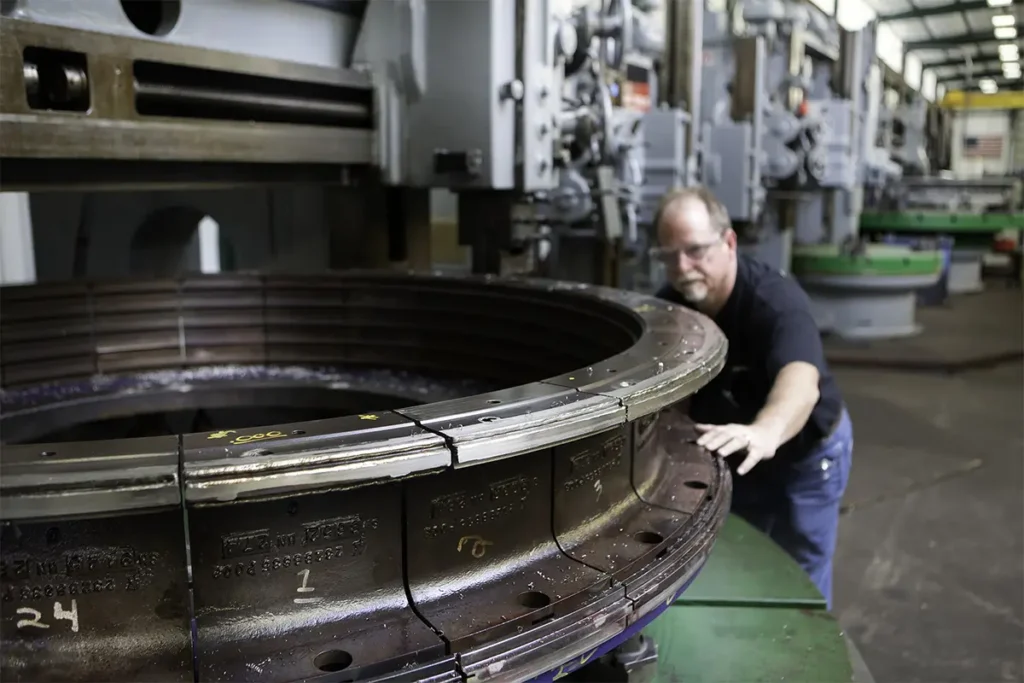
Unplanned turbine downtime is costly. When inspection reveals wear or damage, teams often face a high-stakes choice: repair the component or manufacture a new part. At TRS Services, we support both paths—component restoration and precision new parts manufacturing—across aero-derivative, light industrial, and heavy-duty turbine platforms from GE, Siemens, Alstom, and others. This guide outlines how to compare options so you can balance reliability, schedule, and total lifecycle cost.
What do we mean by “repair” and “new manufacturing”?
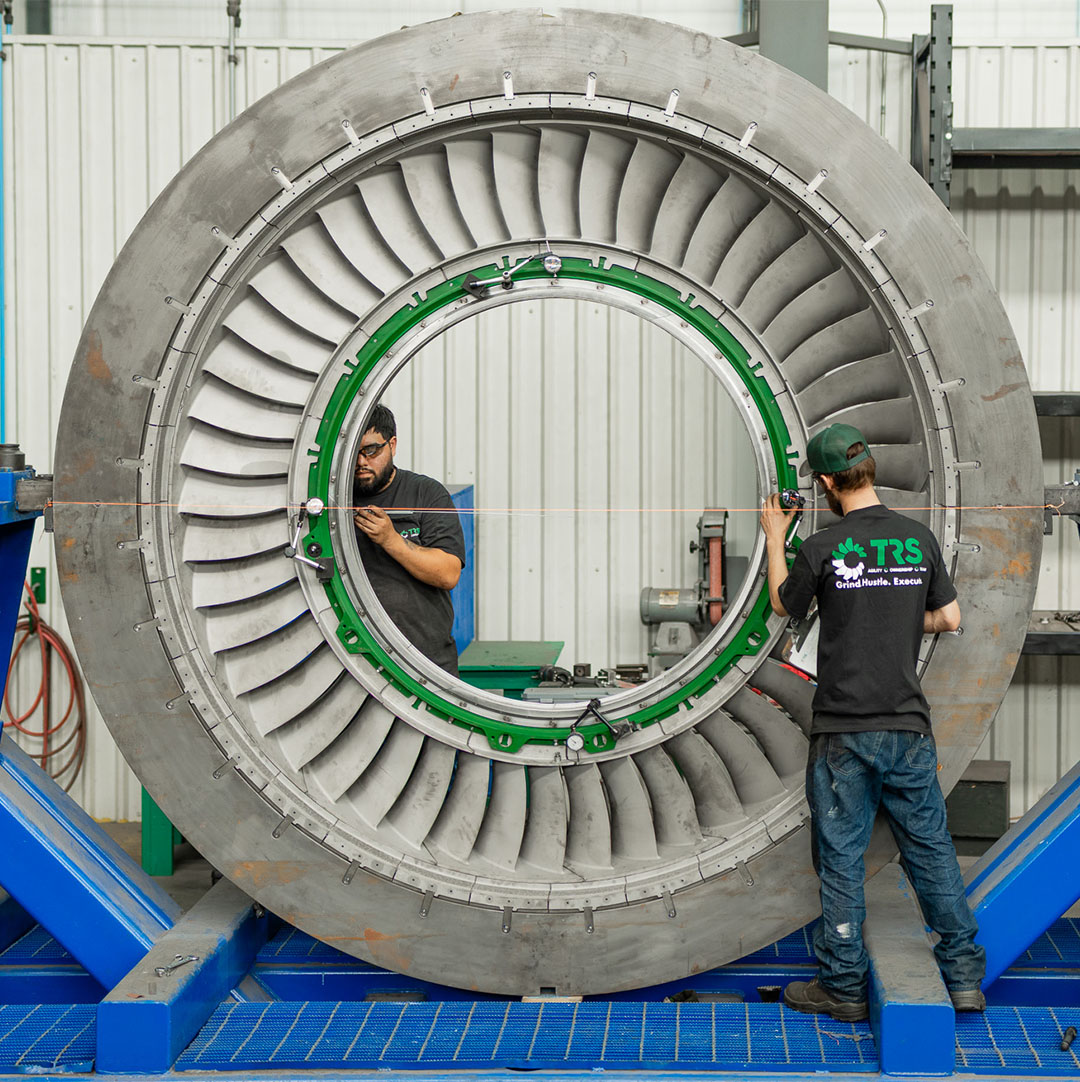
- Component repair: Restoring serviceability and performance through processes such as weld/braze restoration, precision machining, straightening, and recoating—followed by rigorous inspection and balance/alignment as needed.
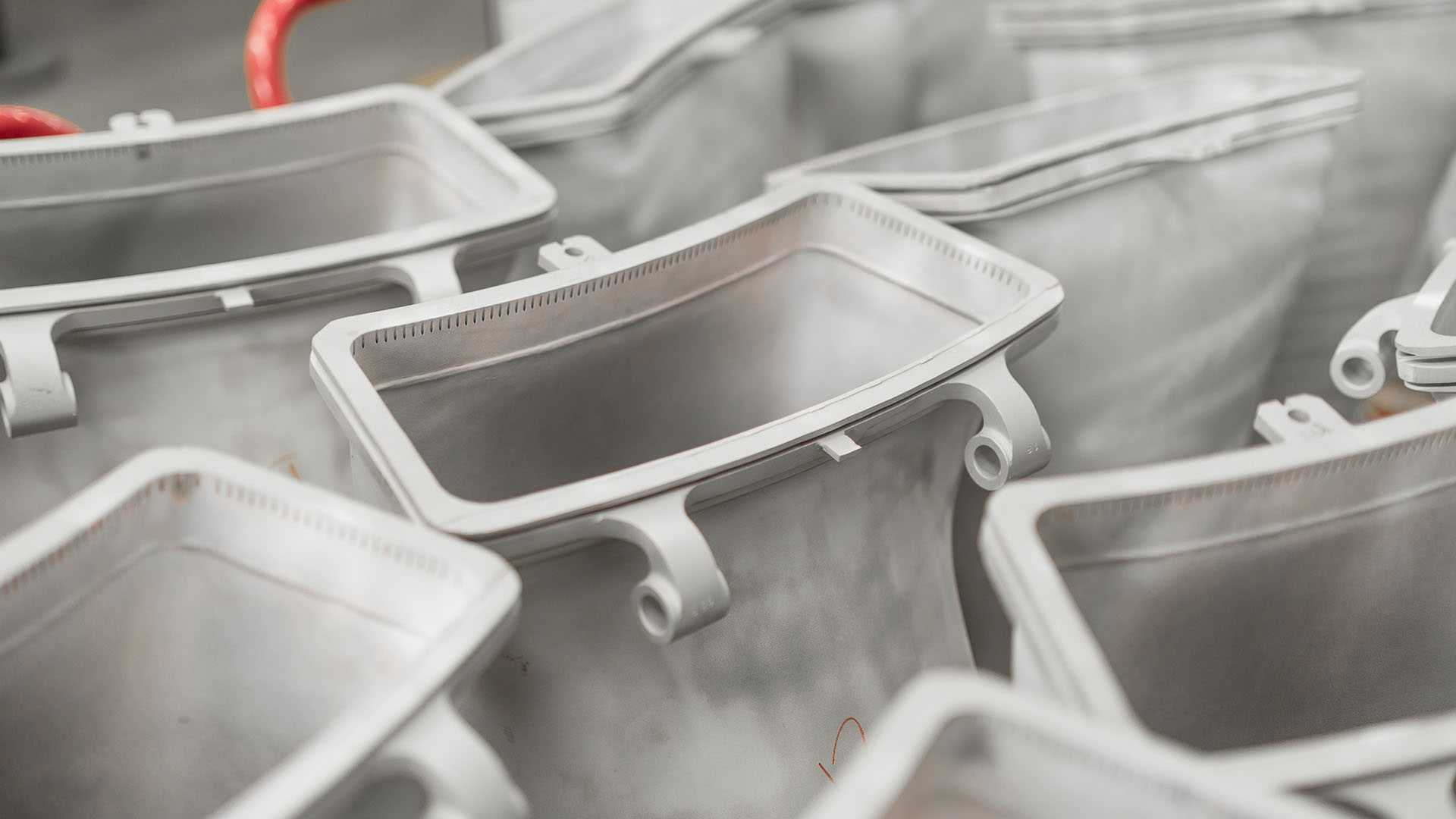
- New parts manufacturing: Building a replacement component to print and specification, with full dimensional control, material and coating compliance, and traceability.
Seven decision drivers to compare repair vs. new
Outage window and lead time
- Repair can often be faster when damage remains within repairable limits, helping you meet a fixed outage schedule.
- New manufacturing may be the better choice if repair scope is uncertain or if the part’s condition risks scope growth during the outage.
- Tip: Build a contingency plan for both paths. TRS provides outage checklists and contingency planning resources to de-risk schedule decisions.
Remaining life and damage mode
- Repair is favored for damage modes like tip wear, minor platform cracks, erosion, and coating loss—provided non-destructive evaluation (NDE) confirms structural margins.
- New manufacturing is prudent when you see advanced thermal fatigue, high creep strain, severe root or dovetail wear, or distortion beyond repair limits.
- The engineering disposition should be grounded in inspection data and known fleet experience for your model and duty cycle.
Lifecycle cost vs. upfront price
- Don’t compare only the purchase order values. Consider:
- Expected run time to next outage
- Efficiency impact (e.g., surface finish, clearances, sealing)
- Inspection/repair costs at the next interval
- Risk-weighted cost of rework or early removal
- A more expensive new part can be the better lifecycle value if it buys longer intervals or improved performance. Conversely, a quality repair can deliver the best ROI if it restores life at a fraction of replacement cost.
Reliability and risk tolerance
- For components on the outage critical path or with high consequence-of-failure, new parts may reduce risk if repair margins are tight.
- For non-critical components or where failure modes are well understood and fully mitigated by repair procedures, restoration is often the most efficient path.
Performance and upgrades
- Repairs can return parts to blueprint dimensions and clearances; in many cases, coatings and dimensional controls restore performance.
- New manufacturing may allow you to incorporate design or material improvements specific to your operating conditions. Evaluate whether these upgrades translate into measurable plant benefits.
Fleet strategy and spares
- Repair becomes even more attractive when paired with an exchange/spares strategy—keeping a repaired set ready reduces future outage risk.
- New parts can help standardize a mixed fleet and simplify future maintenance if your current inventory is highly varied.
- Compliance and traceability
- Both paths can meet applicable specifications when executed correctly. Ensure you will receive the documentation your QA program requires (material certs, coating reports, dimensional records, NDE results, balance/alignment data).
Component-by-component considerations
- Buckets/blades and nozzles/vanes:
- Repair: Tip rebuild, trailing edge restoration, crack removal, platform and seal repairs, and recoating are common.
- New: Consider when creep strain is high, root/dovetail wear is beyond limits, airfoil distortion is significant, or when you want model-specific upgrades.
- Rotors and shafts:
- Repair: Journal/bearing surface restoration, straightening, keyway repair, and precision balance can extend service life.
- New: Typically longer lead times; reserved for severe damage or when a strategic upgrade is planned.
- Casings, diaphragms, and stationary components:
- Repair: Crack remediation, line boring, machining of fits, and alignment corrections are routine.
- New: Preferable if distortion compromises alignment or sealing beyond recoverable limits.
- Seals and ring segments:
- Repair: Restore clearances and surfaces when within tolerances.
- New: When wear or distortion prevents sealing performance from being recovered.
- Combustion components:
- Repair: Patches, crack removal, and coatings can be effective within thermal damage limits.
- New: When hot spots, burn-through, or extensive fatigue exceed allowable repair scope.
A practical evaluation workflow (The TRS Way)
- Inspect and baseline
- Perform targeted NDE and dimensional checks to quantify damage and distortion.
- Engineering disposition
- Define repairable limits and replacement triggers for each component.
- Side-by-side scenarios
- Compare repair vs. new on schedule, cost, risk, and expected run-time.
- Contingency planning
- Pre-approve a Plan B. If a part fails repair inspection, a new-part path should be ready to execute without delaying the outage.
- Quality and documentation
- Establish acceptance criteria and required records before work begins.
Myths to avoid
- “New is always better.” Not if lead times slip your outage or if the lifecycle value of a quality repair is superior.
- “Repair is always cheaper.” Not if the part is near end-of-life or if repair uncertainty risks rework, extra inspections, or early removal.
- “You can decide on price alone.” The right choice balances time, reliability, lifecycle cost, and fleet strategy.
When repair tends to win
- The damage mode is well understood and within limits
- You have a fixed outage window and need schedule certainty
- You’re optimizing lifecycle value across a fleet, not just a single event
- Documentation and QA needs are fully satisfied by the repair process
When new parts tend to win
- The component is structurally compromised or near end-of-life
- You want design/material upgrades that materially improve performance
- Critical-path or high-consequence components require maximum margin
- You’re standardizing a diverse fleet and building a long-term spares base
How TRS can help
TRS delivers complete turbine solutions—component restoration, precision new parts manufacturing, and field consulting—for power generation, oil and gas, and chemical processing. Our team partners with plant managers and engineering leaders to:
- Reduce unplanned outages with smart planning and clear decision criteria
- Minimize total lifecycle cost through data-driven repair vs. replace choices
- Align work scopes to your schedule with proven outage checklists and contingency planning
- Support GE, Siemens, Alstom, MHI and other platforms across aero-derivative, light industrial, and heavy-duty classes
Get Started
Have a component you’re deciding to repair or replace? Contact TRS to compare options with schedule, cost, and risk laid out side-by-side. Explore our Component Repair and New Parts Manufacturing services, and tap into resources like outage checklists and contingency planning to de-risk your next event.
Contact TRS Services:
- 2105 Skinner Rd., Houston, TX 77093
- (713) 692-2930
- sales@trsservices.com