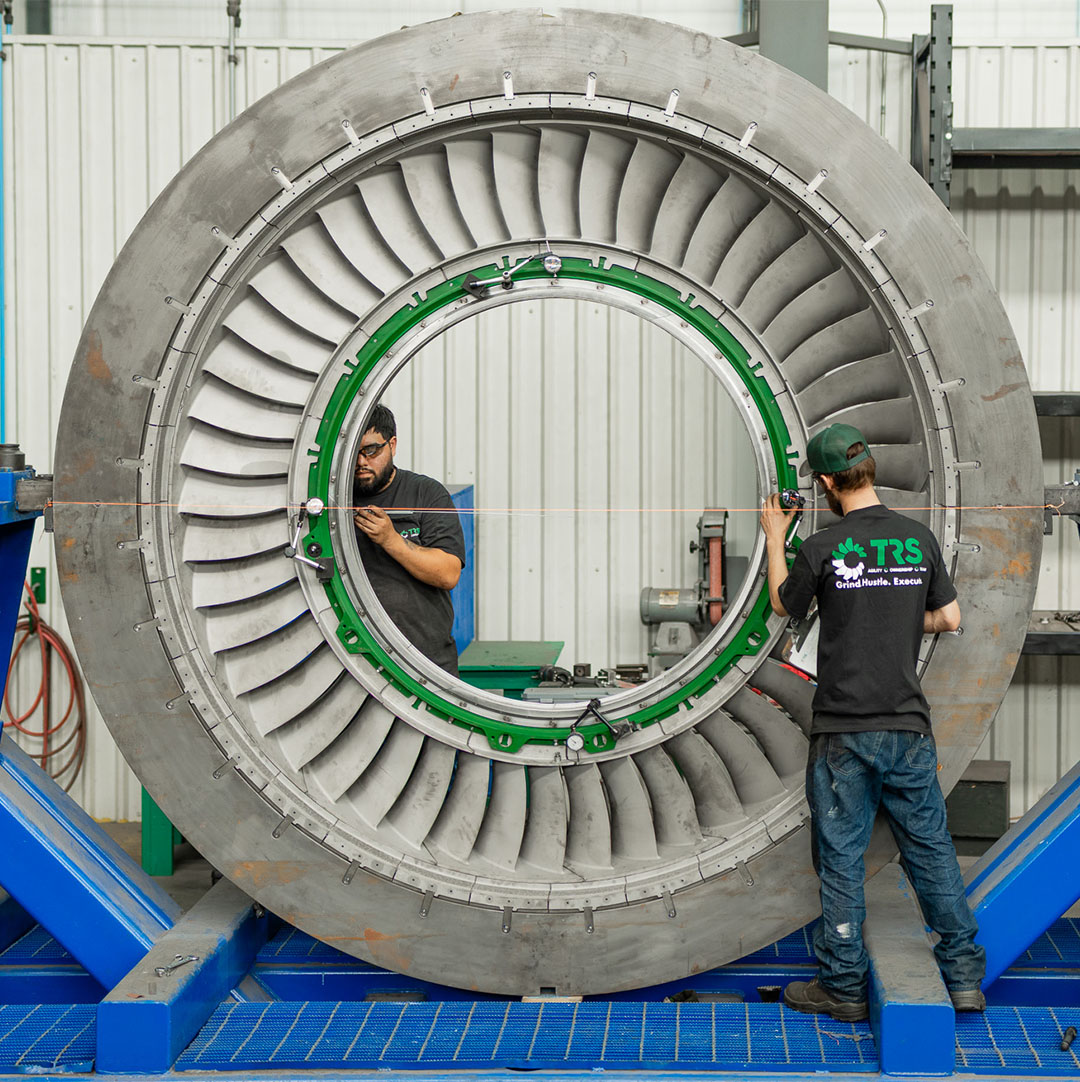
Every turbine outage has unknowns. The difference between a smooth return to service and a schedule overrun is usually decided long before the first casing bolt is loosened—through practical, disciplined contingency planning. At TRS Services, we help plant teams build and execute outage plans that anticipate common failure modes, pre-approve alternatives, and keep the critical path moving across GE, Siemens, Alstom, MHI, and other aero-derivative, light industrial, and heavy-duty platforms.
What is contingency planning for turbine outages?
It’s the deliberate work of converting uncertainty into pre-authorized, pre-sourced, and pre-sequenced options so your team can make fast, high-quality decisions during teardown and inspection. That includes:
- Decision trees with inspection-based triggers (repair, replace, or upgrade)
- Pre-qualified vendors and shops for rapid turn repair and coatings
- Kitted spares and exchange sets staged and ready
- Locked-in logistics, documentation, and QA requirements
- Clear authority and communication paths
Five ways contingency planning protects schedule, cost, and reliability
Faster decisions at discovery
- Inspection triggers linked to go/no-go limits remove debate and prevent analysis paralysis.
- Pre-approved scopes let you authorize work in minutes instead of days.
Parallel work paths
- While one component is being evaluated, repair/new-part options are already in motion.
- Exchange sets and on-call machining prevent single-point delays on the critical path.
Controlled costs
- Pre-negotiated rates and defined acceptance criteria reduce change orders and rework.
- Fewer expedite fees when shipping, tooling, and consumables are planned upfront.
Assured quality and safety
- Predefined NDE methods, hold points, and documentation requirements keep the job compliant.
- Known fixtures, rigging plans, and handling procedures reduce lift and FME risks.
Better cross-team coordination
- A decision authority matrix and daily risk reviews keep stakeholders aligned and issues visible.
- Vendors, OEM/ISP partners, and site trades operate from the same playbook.
Build a practical outage contingency playbook
- Risk register and triggers
- Rank components by likelihood and consequence of common damage (erosion, cracks, creep, distortion, coating loss).
- Define quantitative triggers: crack length/locations, out-of-round, bow, tip gap, dovetail wear, coating thickness.
- Component disposition matrix (repair vs. new)
- For each part: inspection steps, repairable limits, replacement thresholds, and upgrade options.
- Tie decisions to timeline checkpoints (T-60/T-30/T-7 days, Day 0, +24h) and to specific vendors.
- Spares and exchange strategy
- Stage hot gas path exchange sets, ring segments, seals, fasteners, and critical consumables.
- Identify acceptable alternates and interchangeability notes across mixed fleets.
- Long-lead materials and consumables
- List by lead time and risk: forgings, castings, coatings, weld wire, specialty fasteners, insulation, gaskets.
- Place “release-on-call” POs with alternates to avoid stock-outs.
- Vendor and process readiness
- Pre-qualify repair/coating shops with documented procedures, capacities, and turnaround commitments.
- Align on traveler templates, balancing and runout specs, and required certs.
- Logistics and staging
- Pre-book carriers, crates, preservation materials, humidity controls, and insurance.
- Map laydown zones, flow lanes, and clean/dirty boundaries for parts handling.
- QA and documentation
- Define NDE techniques (FPI, UT, EC, X-ray), acceptance criteria, and photo/measurement records.
- Establish serialization, dimensional checkpoints, and coating/balance reports.
- Schedule architecture
- Insert deliberate “float pockets” and parallel-path activities.
- Set hard go/no-go dates for switching from repair to new parts to protect the return-to-service date.
- Decision authority and communications
- Document who can approve spend, deviations, and scope changes at each threshold.
- Run daily risk stand-ups and publish a simple issue log with owners and ETAs.
Common mid-outage discoveries—and prebuilt responses
- Nozzle or vane cracking
- Plan A: Ship to pre-qualified repair shop; expedite coating on return.
- Plan B: Swap to staged exchange segments; return originals to repair for next outage.
- Bucket/blade tip wear or platform damage
- Plan A: Tip rebuild, blend, and recoat within defined limits.
- Plan B: Pull from kitted spares; use repair path for future rotation.
- Ring segment or seal rubs and distortion
- Plan A: Machine back to tolerance; restore coatings as needed.
- Plan B: Replace with pre-staged segments if machining would compromise sealing.
- Rotor runout or journal damage
- Plan A: In-situ checks, minor journal restoration, and precision balance.
- Plan B: Send to a qualified shop for straightening; have replacement bearings and liners ready.
- Combustion hot spots or burn-through
- Plan A: Localized repair and coatings within thermal damage limits.
- Plan B: Replace chambers/caps/liners from inventory; incorporate upgrades if justified.
Quantifying the value
- Schedule: Pre-authorized options and pre-kitted parts can compress recovery decisions from days to hours.
- Budget: Fewer expedite fees, lower rework risk, and fewer change orders.
- Reliability: Restored or upgraded components with proper QA reduce early removals.
- Safety/compliance: Standardized handling, NDE, and documentation reduce incident and audit risk.
Myths to avoid
- “We’ll decide once we see it.” Teardown time is too late to source parts, qualify vendors, or align QA.
- “Contingencies cost too much.” The carrying cost of a spare or standby PO is small versus a slipped return-to-service.
- “OEM will cover everything.” Mixed fleets and legacy units often require independent repair and sourcing options.
A simple 60/30/7/0-day timeline
- T-60: Risk workshop, disposition matrices, vendor qualifications, long-lead POs, logistics plan.
- T-30: Stage spares and tools, confirm QA plans and documentation, align authority matrix, rehearse decision trees.
- T-7: Final readiness review, crate labels and shipping docs prepared, daily risk review cadence established.
- Day 0+: Execute inspection plan; trigger prebuilt decisions; hold daily risk stand-ups; switch paths at pre-set go/no-go dates.
The TRS Way: Turning plans into performance
TRS partners with plant managers and engineering leaders to:
- Facilitate pre-outage risk and contingency workshops
- Build component-specific repair vs. new decision trees and inspection plans
- Pre-qualify repair, coating, and new-part manufacturing paths to protect the schedule
- Kit spares, consumables, and tooling; align logistics and QA documentation
- Support aero-derivative, light industrial, and heavy-duty platforms across GE, Siemens, Alstom, MHI, and others
Get started
Planning an outage or building a contingency playbook? TRS can help you compare options side-by-side, pre-stage resources, and de-risk your timeline.