Gas turbines are engineered to operate under demanding conditions, but even the most durable equipment experiences wear over time. High temperatures, rapid rotational speeds, repeated operating cycles, contaminants, and mechanical stress can gradually affect critical turbine components. Understanding the primary gas turbine degradation causes is essential for maintaining efficiency, preventing unexpected failures, and extending equipment life.
According to TRS Services, gas turbine components operate in some of the harshest industrial environments. Common contributors to degradation include high-temperature oxidation, thermal fatigue, corrosion, erosion, and mechanical stress.
By recognizing these factors early and implementing proactive maintenance strategies, operators can help protect their equipment and maintain reliable turbine performance.
What Is Gas Turbine Degradation?
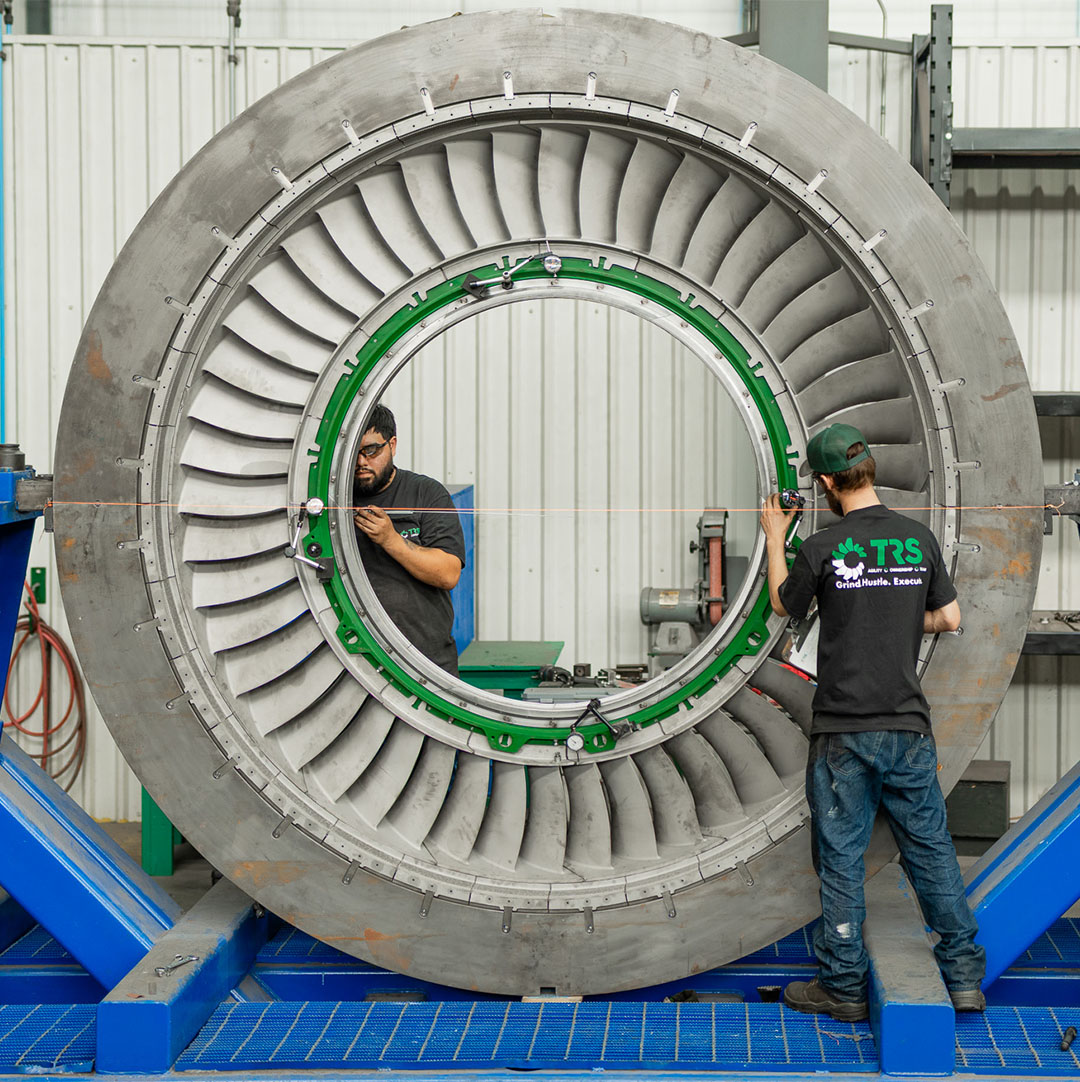
Gas turbine degradation refers to the gradual deterioration of components and performance caused by operating conditions, environmental exposure, and mechanical stresses. Over time, degradation can affect components such as turbine blades, vanes, combustion liners, transition pieces, fuel nozzles, and compressor components.
As these parts deteriorate, the turbine may experience reduced efficiency, increased fuel consumption, lower output, or greater risk of an unplanned outage.
TRS Services works with major industrial turbine platforms, including GE, Siemens, Alstom, and MHI equipment, providing component restoration, precision manufacturing, and other turbine support services.
Why Turbine Degradation Matters
Turbine degradation is more than a normal maintenance concern. If damage continues unchecked, relatively minor wear can develop into more significant component problems.
Potential consequences include:
- Reduced turbine efficiency
- Loss of power output
- Increased maintenance requirements
- Higher operating costs
- Greater risk of component failure
- Longer or more expensive outages
Understanding the condition of individual components allows maintenance teams to address problems before they become larger operational issues.
High Temperatures and Thermal Stress
High operating temperatures are among the most significant gas turbine degradation causes. Turbine components must withstand extreme thermal conditions, particularly in areas exposed to hot combustion gases.
Repeated exposure to high temperatures can contribute to oxidation, coating deterioration, thermal fatigue, and other forms of material degradation. Start-and-stop cycles can make the problem more pronounced because components repeatedly expand and contract as operating temperatures change.
TRS Services identifies high-temperature oxidation and thermal fatigue from repeated start and stop cycles as important contributors to turbine component degradation.
Over time, these effects can compromise component integrity and contribute to declining performance.
Corrosion From Fuel and Air Contaminants
Corrosion is another important factor affecting turbine components. Contaminants introduced through fuel or intake air can create an aggressive environment for metal surfaces and protective coatings.
Once protective layers become compromised, underlying materials can become increasingly vulnerable to deterioration.
Operators can reduce exposure by paying close attention to:
- Fuel quality
- Air filtration effectiveness
- Intake system cleanliness
- Protective coating condition
- Signs of corrosion during inspections
TRS recommends monitoring fuel quality and air filtration effectiveness as part of an approach to reducing contaminant exposure and minimizing erosion and corrosion.
Erosion and Particulate Damage
Particles entering the turbine or compressor can gradually wear exposed surfaces. Erosion may affect blades, vanes, and other components, potentially changing their original geometry.
Even relatively small changes in component shape can matter because turbine components are designed with precise aerodynamic profiles and clearances. Damage to those surfaces can contribute to turbine performance degradation.
Regular inspections can help identify erosion before it progresses to a point where more extensive restoration or replacement is required.
Mechanical Stress and High-Speed Operation
Gas turbines operate at extremely high rotational speeds, placing substantial mechanical demands on rotating components. Continuous operation under these conditions can contribute to fatigue, distortion, vibration-related problems, and other forms of mechanical wear.
Mechanical stress does not occur independently of other degradation mechanisms. Thermal cycling, vibration, corrosion, and erosion can interact with mechanical loads and accelerate component deterioration.
For this reason, evaluating turbine health requires more than looking for obvious surface damage.
How Turbine Degradation Affects Performance
Component deterioration can gradually reduce how effectively a gas turbine converts fuel into useful power. Changes in blade geometry, clearances, coatings, combustion components, or other critical areas can influence overall operation.
This is why turbine performance degradation should be monitored alongside physical component condition.
Performance monitoring and trending can help identify abnormal changes before they develop into major problems. TRS Services recommends performance monitoring and trending, along with vibration analysis, borescope inspections, nondestructive testing, and clearance and alignment checks as components of a proactive maintenance program.
Tracking performance over time also gives operators a useful baseline for determining when an inspection or maintenance intervention may be necessary.
How to Reduce Turbine Wear
Knowing how to reduce turbine wear starts with understanding the conditions affecting the equipment. There is no single maintenance action that eliminates every form of degradation. Instead, operators should combine monitoring, inspection, preventive maintenance, and appropriate component restoration.
Schedule Regular Inspections
Routine inspections can reveal cracking, corrosion, erosion, coating loss, and dimensional changes before they become more serious.
Depending on the turbine and maintenance strategy, inspections may include:
- Borescope inspections
- Visual and dimensional inspections
- Non-destructive testing
- Vibration analysis
- Clearance measurements
- Alignment checks
- Performance trending
TRS Services emphasizes early identification of wear and damage as a key part of extending component life and preventing more costly failures.
Maintain Protective Coatings
Protective coatings help turbine components withstand heat, oxidation, and corrosion. When coatings deteriorate, restoring them can provide an important layer of protection.
TRS notes that refurbishment processes can include recoating protective thermal barrier coatings as well as applying oxidation-resistant and corrosion-resistant coatings.
Maintaining these protective systems can therefore be an important part of a long-term turbine maintenance strategy.
Repair and Refurbish Components When Appropriate
Not every worn component needs to be replaced with a new part. Depending on the extent and location of damage, qualified repair specialists may be able to restore components to a serviceable condition.
TRS Services describes repair processes that can include precision welding, brazing, machining, coating restoration, and rigorous inspection and nondestructive testing. Components such as combustion liners, fuel nozzles, transition pieces, turbine blades, buckets, vanes, and compressor components may be candidates for restoration depending on their condition.
Refurbishment can also help operators manage lifecycle costs while extending the useful life of valuable components.
Monitor Operating Conditions
Operating a turbine outside recommended temperature or load ranges can accelerate wear. Keeping operating conditions within appropriate limits can help reduce unnecessary stress on components.
Important parameters to monitor include:
- Turbine inlet temperature
- Exhaust temperature spread
- Fuel quality
- Air filtration performance
- Vibration
- Overall turbine performance
Trend data can be particularly useful because gradual changes may reveal developing problems before they become obvious during normal operation.
Use a Proactive Maintenance Strategy
Reactive maintenance waits for a component to fail or show severe deterioration. A proactive strategy looks for developing problems and addresses them during planned maintenance opportunities.
A comprehensive approach may combine inspections, predictive analytics, component repair, refurbishment, and lifecycle planning. TRS Services recommends using performance data and trends to help forecast component degradation and enable preemptive intervention.
This approach can help operators reduce the likelihood of unexpected outages while making better use of planned maintenance windows.
When Should a Component Be Repaired or Replaced?
The right response to degradation depends on the component’s condition, engineering limits, cost, expected service life, and operational requirements.
Localized damage may be suitable for repair when the component’s structural integrity remains intact and required tolerances can be restored. More severe fatigue, creep, distortion, or damage to critical fits may make replacement a better option.
A proper evaluation should consider more than the immediate repair price. Operators should also consider:
- Expected remaining service life
- Repair and replacement costs
- Lead time
- Potential downtime
- Failure risk
- Future maintenance requirements
- Overall lifecycle cost
TRS Services recommends evaluating repair-versus-replacement decisions using inspection results and lifecycle cost considerations rather than relying on assumptions or habit.
Protecting Turbine Performance Over the Long Term
Gas turbine degradation cannot be eliminated entirely because these machines operate under intense thermal, mechanical, and environmental conditions. However, understanding the major degradation mechanisms makes it possible to manage their effects.
High temperatures, thermal cycling, contaminants, particulate erosion, and mechanical stress can all contribute to component deterioration. Regular inspections, performance monitoring, protective coatings, preventive maintenance, and qualified repair services can help operators respond before wear develops into a more serious problem.
Ultimately, learning how to reduce turbine wear is about taking a proactive approach to equipment health. By combining reliable condition monitoring with timely maintenance and professional component restoration when appropriate, operators can work toward maintaining turbine performance, extending component life, and reducing the risk of costly unplanned downtime.