In turbine operations, the decision between repairing an existing component and investing in new turbine parts manufacturing is rarely straightforward. While repair has long been viewed as the cost-saving default, evolving supply chains, tighter performance tolerances, and shifting outage expectations have changed the calculus. Today, the smarter decision often comes down to three interconnected drivers: lead time, tolerance capability, and total lifecycle cost.
This article breaks down how to approach the make vs repair turbine decision with a practical, engineering-first mindset.
Understanding the Core Decision: Repair vs. New
At a high level:
This decision sits at the heart of turbine maintenance strategy, and our companion guide on repair vs. replace for critical turbine components walks through the same tradeoff from a life-cycle cost perspective.
- Repair restores an existing component using processes like welding, machining, recoating, and balancing.
- New manufacturing produces a replacement part to full specification with material traceability and dimensional precision.
Both paths can be valid—but they serve different operational priorities.
1. Turbine Spare Parts Lead Time: The Hidden Driver
Lead time is often the deciding factor, especially during planned outages or forced downtime.
Why lead time matters more than ever:
- Supply chain constraints have extended delivery timelines for new turbine components—sometimes dramatically.
- Large-scale turbine procurement can stretch into months or even years, depending on demand and complexity.
- Even component-level sourcing is impacted by:
- Material availability
- Shop capacity and backlog
- Certification and inspection requirements
Repair advantage:
- Faster turnaround when damage is within repairable limits
- Better alignment with fixed outage windows
- Reduced exposure to supply chain volatility
When new wins on lead time:
- If repair scope is uncertain and risks expanding mid-outage
- When pre-planned procurement avoids emergency delays
- When repair failure would trigger cascading downtime
In short: short-term urgency favors repair—but predictable planning can favor new manufacturing.
2. Tolerance and Engineering Limits
Not every component can—or should—be repaired.
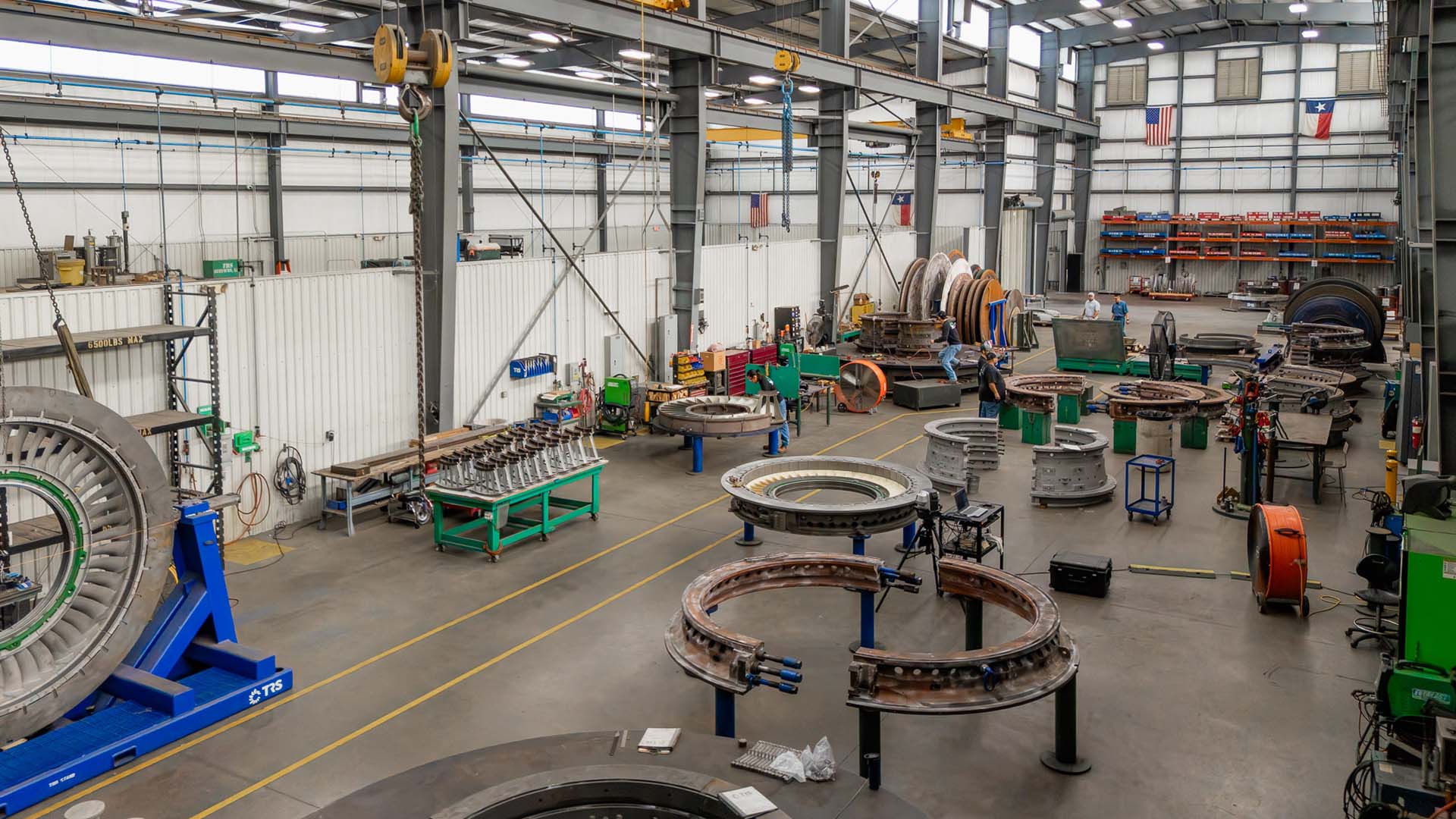
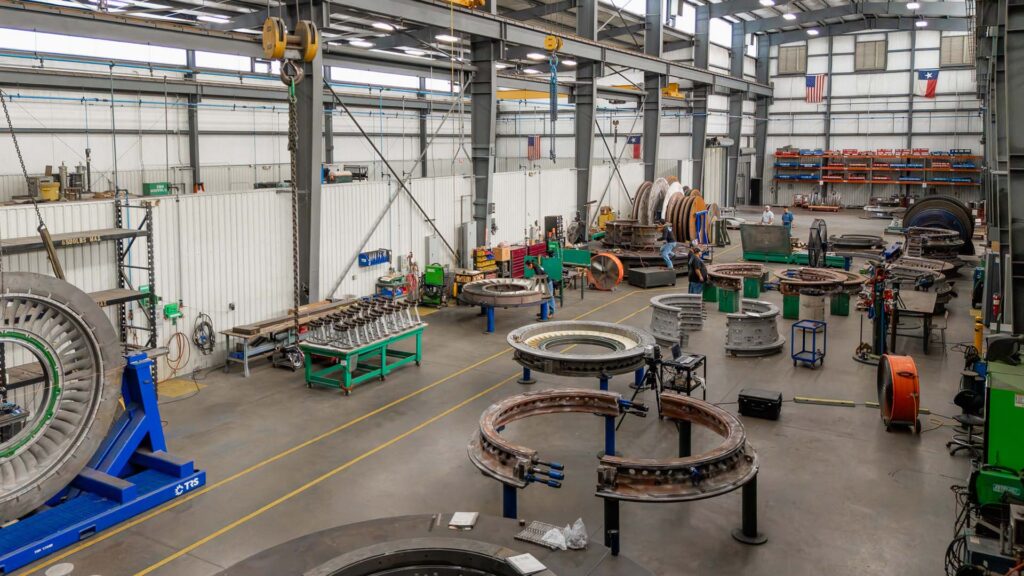
These tolerances are held to OEM specification using the precision equipment in TRS’s shop.
Repair works best when:
- Damage is localized (e.g., wear, minor cracking, coating loss)
- Structural integrity remains intact
- Tolerances can be restored within acceptable limits
New turbine parts manufacturing becomes necessary when:
- There is advanced fatigue, creep, or distortion
- Critical fits (e.g., dovetails, sealing surfaces) are compromised
- Repeated repairs have consumed remaining material margins
Why tolerance matters:
Turbines operate under extreme thermal and mechanical stress. Even small deviations can affect:
- Efficiency (clearances, airflow)
- Vibration and balance
- Component life and failure risk
New parts provide full dimensional reset, which can:
- Restore original performance
- Enable design upgrades
- Reduce uncertainty in high-risk components
3. Total Cost vs. Upfront Price
A common mistake is focusing only on initial cost. In reality, the decision should be based on total lifecycle cost (LCC).
Key cost factors to evaluate:
- Initial repair vs. replacement cost
- Expected runtime until next outage
- Efficiency impacts (fuel, output)
- Maintenance frequency and future repairability
- Risk-weighted cost of failure or early removal
Typical cost dynamics:
- Repair can cost significantly less upfront, sometimes a fraction of replacement
- New parts may deliver:
- Longer service intervals
- Lower maintenance costs
- Improved performance efficiency
A practical way to think about it:
- Repair = lower cost now, potentially higher cost later
- New = higher cost now, potentially lower cost over time
4. Risk Tolerance and Criticality
Not all components carry the same operational risk.
For a deeper, component-by-component breakdown of these tradeoffs, see our full guide to choosing between component repair and new parts manufacturing.
Choose repair when:
- The component is non-critical
- Failure consequences are manageable
- Repair processes are well-proven
Choose new manufacturing when:
- The part is on the critical path of an outage
- Failure would cause significant production loss
- Engineering margins are tight
A risk-adjusted approach ensures you’re not just saving money—but protecting uptime.
5. Performance and Strategic Upgrades
One often-overlooked factor in the make vs repair turbine decision is performance improvement.
Repair can:
- Restore original geometry and coatings
- Recover efficiency lost to wear
New manufacturing can:
- Incorporate updated materials or coatings
- Improve thermal resistance or durability
- Optimize performance for current operating conditions
In some cases, new is not just replacement—it’s an upgrade path.
6. A Practical Decision Framework
To systematically evaluate repair vs. new:
Once a component is approved for new manufacturing, careful logistics matter too — see our guide on safe handling from crate to install.
- Inspect and quantify damage
- Use non-destructive evaluation and dimensional checks
- Define repair limits
- Establish clear accept/reject criteria
- Compare both paths side-by-side
- Lead time
- Cost
- Risk
- Expected service life
- Plan contingencies
- Always have a backup option if repair fails
This structured approach reduces uncertainty and avoids costly surprises.
When New Beats Repair
While repair is often the default, new turbine parts manufacturing is the better choice when:
- Lead time can be planned in advance
- Damage exceeds repairable limits
- Tolerance restoration is uncertain
- Lifecycle cost favors longer service intervals
- Risk of failure is unacceptable
Key Takeaways
- Turbine spare parts lead time is now a primary decision driver, not a secondary consideration
- Repair is faster and cheaper upfront—but not always the best long-term value
- New manufacturing provides certainty in tolerance, performance, and lifespan
- The smartest decisions come from balancing cost, risk, and schedule—not optimizing just one
Final Thought
The “repair vs. replace” debate isn’t about choosing the cheaper option—it’s about choosing the most predictable and cost-effective outcome over time. In today’s environment of extended lead times and higher performance demands, there are many cases where new truly beats repair—and knowing when is what separates reactive maintenance from strategic asset management.
When the data points to new manufacturing, TRS’s new parts manufacturing team can take a component from design through delivery with full material traceability.